

Denver’s path to 100% renewable electricity by 2030 relies on four primary energy sources: solar, wind, hydroelectric, and geothermal. For businesses and organizations in the Mile High City, understanding these energy types isn’t just about environmental compliance. It’s about joining a thriving local movement that’s already transforming how companies power their operations, reduce costs, and contribute to one of the most ambitious clean energy transitions in the United States.
Since the city committed to this goal, Denver has seen remarkable progress across all four renewable sectors. Solar installations have spread from rooftops in RiNo to carports in the Tech Center. Wind power flows into the grid from eastern Colorado’s plains. Hydroelectric facilities along the South Platte continue their quiet, century-long work. Emerging geothermal projects hint at what’s next.
The shift affects every sector. Local manufacturers are installing solar arrays to hedge against energy volatility. Property managers are exploring geothermal heating to cut building emissions. Tech companies are demanding renewable energy certificates to meet sustainability commitments. Even small nonprofits are finding ways to participate through community solar programs.
What makes Denver’s approach work is its practical focus. The city doesn’t expect every organization to become an energy expert overnight. Instead, it provides clear pathways for participation at every scale, from purchasing renewable energy credits to installing on-site generation. The result is a renewable energy ecosystem where businesses of all sizes can find their entry point and contribute to 2030’s shared goal.
Solar Energy: Denver’s Brightest Opportunity
Commercial Solar Success Stories
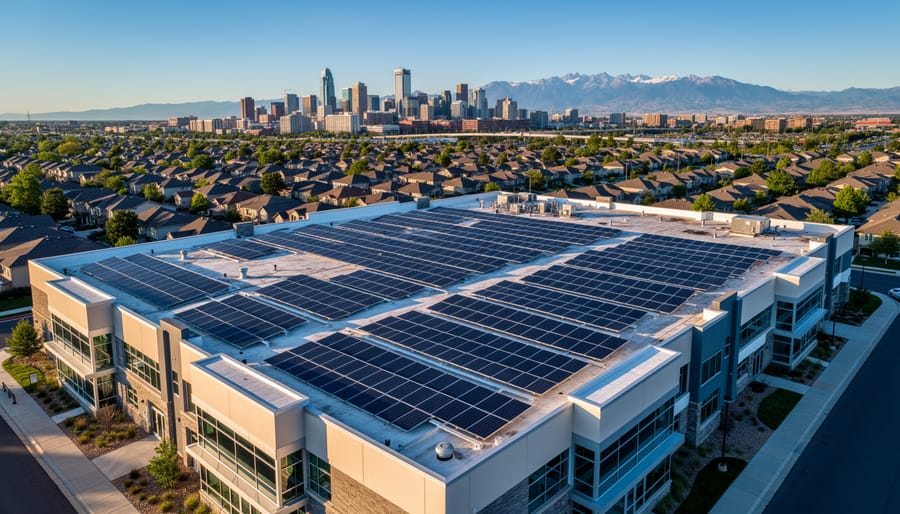
Denver’s commercial sector is proving solar power works at scale. The Crawford Hotel at Union Station installed a 1.4-megawatt solar array in 2014, one of the city’s largest urban installations at the time. The system generates roughly 1.7 million kilowatt-hours annually, offsetting about 30% of the hotel’s electricity needs and preventing over 1,200 metric tons of CO2 emissions each year.
The Denver Museum of Nature & Science took a different approach, partnering with a solar garden program rather than rooftop panels. This arrangement allowed the museum to purchase renewable energy without structural modifications to its historic building, reducing its carbon footprint by 15% while maintaining preservation standards.
Several event venues have followed suit. The National Western Center incorporated a 750-kilowatt solar installation into its redevelopment plan, designed to provide clean power for year-round events and exhibitions. The facility benefits from Denver’s nearly 300 days of sunshine making solar panels productive even during winter months.
Local brewery Wynkoop Brewing Company added rooftop solar in 2019, cutting electricity costs by 22% in the first year. Owner John Hickenlooper’s team reported that the system paid for itself faster than projected, thanks to Xcel Energy’s Solar*Rewards program and federal tax credits.
These organizations share a common thread: they didn’t wait for perfect conditions. They evaluated their options, secured financing through green business loans or power purchase agreements, and moved forward with installations sized to their actual energy loads.
Getting Started with Solar for Your Organization
Evaluating solar power for your Denver organization starts with understanding your current energy consumption and building characteristics. Request your last 12 months of utility bills from Xcel Energy to establish your baseline electricity usage and costs. This data reveals your organization’s consumption patterns and identifies peak demand periods that solar could offset.
Next, assess your facility’s solar potential. South-facing rooftops with minimal shading offer the best returns, but east and west orientations can still prove viable in Denver’s sunny climate. For organizations without suitable roof space, community solar programs provide access to solar energy without on-site installation.
Here’s your practical roadmap to solar adoption:
- Conduct a professional solar assessment through certified installers who understand Denver’s building codes and incentive programs
- Compare financing options including direct purchase, power purchase agreements (PPAs), and solar leases to determine which aligns with your organization’s capital structure and sustainability goals
- Explore federal Investment Tax Credit (ITC) opportunities and state-level incentives that reduce upfront costs by 30% or more
- Request proposals from at least three Denver-area solar vendors, ensuring quotes include production estimates, warranty terms, and maintenance requirements
- Review your current electricity contract with Xcel Energy to understand net metering benefits and interconnection procedures
- Develop an internal stakeholder presentation showing projected ROI, carbon reduction metrics, and alignment with corporate sustainability commitments
Partner with vendors experienced in commercial installations who can navigate Denver’s permitting process efficiently. Organizations like the Colorado Solar and Storage Association maintain directories of vetted installers. Many Denver solar companies offer zero-cost feasibility studies, making the initial exploration phase risk-free while providing concrete data for decision-making.
Wind Power: Harnessing Colorado’s Natural Resource
How Wind Energy Reaches Denver
Colorado’s eastern plains generate powerful wind energy that travels to Denver through the state’s interconnected electrical grid. When turbines spin in rural areas like Limon or Lamar, sometimes 100 miles from the city, that electricity flows instantly through high-voltage transmission lines managed by Xcel Energy and other utilities.
Think of the grid as a shared pool: wind farms pour clean electricity into one end while Denver draws power from the other. The grid doesn’t distinguish between wind, solar, or conventional energy once it’s flowing, all sources merge together. This means when you flip a light switch in Denver, you’re drawing from whatever mix is available at that moment, increasingly including wind resources across the region.
Denver doesn’t need local turbines to benefit from wind power. Through renewable energy agreements, businesses can financially support specific wind projects while physically receiving electricity from the shared grid. Real-time grid management ensures reliable delivery even when wind speeds fluctuate, with backup sources maintaining consistent power to your facility.
Wind Energy Options for Organizations
Denver organizations have three primary pathways to support wind energy without installing turbines on-site.
Renewable Energy Credits (RECs) let businesses claim the environmental benefits of wind power generated elsewhere. Through Xcel Energy’s Windsource program, companies purchase RECs at a premium of roughly 1.5 to 3 cents per kilowatt-hour above standard rates. Each REC represents one megawatt-hour of wind electricity fed into Colorado’s grid. This option works particularly well for hotels and event venues needing to demonstrate clean energy credentials to guests without capital investment. You can enroll for a portion of your electricity use or commit 100 percent, and the flexible structure accommodates seasonal businesses that scale operations throughout the year.
Community wind programs function similarly to community solar but remain less common in Colorado. These arrangements allow multiple subscribers to share output from a single wind farm, receiving credits on their utility bills proportional to their subscription. While Denver has fewer community wind options than solar gardens currently, regional programs through rural electric cooperatives occasionally open enrollment to Front Range businesses.
Power Purchase Agreements (PPAs) suit larger organizations with substantial electricity needs. Companies contract directly with wind farm developers for long-term energy supply, often locking in predictable rates for 10 to 20 years. Several Denver tech companies and manufacturers have used PPAs to secure significant portions of their electricity from Colorado wind farms, gaining price stability alongside sustainability benefits.
Hydroelectric Power: Tapping into Water Resources

Denver Water’s Renewable Energy Initiatives
Denver Water operates as one of the city’s most significant renewable energy contributors, generating clean electricity while managing the metro area’s water supply. The utility runs six small hydroelectric facilities across its reservoir system, producing approximately 17 million kilowatt-hours annually, enough to power roughly 1,500 homes. These installations capture energy from water flowing between reservoirs and treatment plants, converting gravitational potential into carbon-free electricity.
At Marston Water Treatment Plant, turbines generate power during the water treatment process itself, demonstrating how infrastructure can serve dual purposes. The Foothills Treatment Plant similarly incorporates hydroelectric generation, offsetting a portion of the facility’s energy consumption. Denver Water also installed a 750-kilowatt solar array at its operations complex, part of a broader strategy to power utility operations with renewable sources by 2030.
For Denver businesses, Denver Water’s approach illustrates practical renewable integration within existing infrastructure. The utility’s model shows how organizations with water systems, elevation changes, or treatment processes can explore similar micro-hydro opportunities. These installations provide reliable baseload power that complements intermittent solar and wind sources, contributing steady renewable electricity to Denver’s grid year-round.
The Role of Hydro in Denver’s Energy Mix
Hydroelectric power serves as Denver’s reliability anchor as the city accelerates toward its 2030 renewable electricity goal. Unlike solar and wind, which fluctuate with weather conditions, hydropower delivers consistent baseload electricity that keeps the grid stable when clouds roll in or winds calm.
Denver draws hydroelectric power from several regional sources, including facilities along the Colorado River system and smaller installations at municipal water infrastructure. This steady output becomes increasingly valuable as the city adds more intermittent renewable sources to its energy portfolio.
The flexibility of hydroelectric facilities also matters. Operators can adjust water flow through turbines within minutes to match demand spikes, something solar panels and wind turbines can’t do. This “dispatchability” helps balance the grid during morning and evening peaks when electricity use surges but solar production drops.
As Denver pushes past 50% renewable electricity penetration, hydropower’s stabilizing role grows more critical. It bridges the gap between variable generation and constant demand, reducing the need for fossil fuel backup plants. For businesses concerned about power reliability while supporting renewable goals, hydropower provides the best of both worlds: clean energy that’s always available when needed.
Geothermal and Emerging Technologies: The Future of Denver’s Clean Energy
Geothermal Success in Denver Buildings
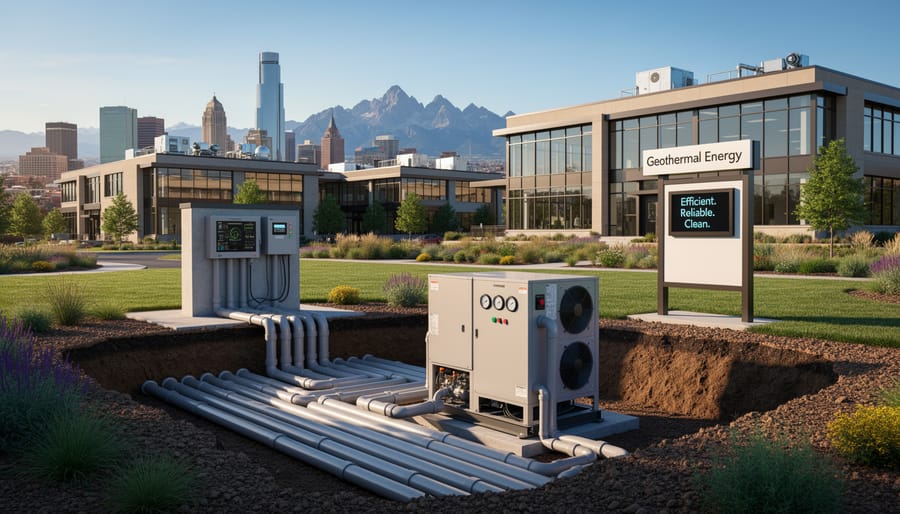
The Hilton Denver City Center has cut its heating and cooling costs by 30% since installing a geothermal system in 2021, tapping into the earth’s constant underground temperature to maintain comfort across 613 guest rooms and 60,000 square feet of meeting space. The system uses water-filled pipes buried 300 feet below the property to exchange heat with the ground, which stays at a steady 50-55°F year-round regardless of Colorado’s temperature swings.
Downtown’s National Western Complex integrated geothermal heating and cooling into its $1.1 billion redevelopment, serving event spaces that host everything from stock shows to sustainability conferences. The system reduces the facility’s carbon footprint by an estimated 40% compared to conventional HVAC, a meaningful shift for a venue that welcomes over a million visitors annually.
The Colorado Convention Center downtown uses a geothermal field covering roughly 5 acres beneath the building’s footprint. This installation handles climate control for 584,000 square feet of exhibit and meeting space while reducing annual energy consumption by 25%. The system pays for itself through lower utility bills while eliminating the rooftop cooling towers that once dominated the building’s appearance.
Smaller commercial buildings are joining in. The Source Hotel + Market Hall in RiNo installed a geothermal system that serves both the 100-room hotel and the adjacent food hall, demonstrating that the technology scales effectively for mixed-use developments. The upfront cost ran about 15% higher than traditional systems, but the property expects full payback within seven years through energy savings.
Energy Storage and Grid Reliability
Battery storage has become essential to Denver’s renewable energy strategy as the city scales up intermittent solar and wind power. Large-scale lithium-ion battery systems now store excess renewable electricity generated during peak production hours, then discharge it during evening demand spikes or when generation drops. This smooths out the natural fluctuations of renewables and prevents grid instability.
Xcel Energy has deployed several battery storage projects across the Denver metro area, with capacities ranging from 10 to 50 megawatts. These installations respond in milliseconds to balance supply and demand, something traditional power plants can’t match. The utility plans to triple its storage capacity by 2028 to support higher renewable penetration.
For commercial facilities, behind-the-meter battery systems offer dual benefits. They provide backup power during outages while also reducing demand charges by drawing stored energy during peak rate periods. Several Denver hotels and convention centers have installed 100-500 kilowatt-hour systems that integrate with their solar arrays.
Grid operators increasingly rely on sophisticated software that predicts renewable generation patterns and coordinates battery dispatch. This technology allows Denver to maintain the same reliability standards while dramatically increasing the share of clean electricity powering homes and businesses.
Taking Action: How Your Organization Can Support Denver’s 2030 Goal
Supporting Denver’s 2030 renewable electricity goal isn’t just about environmental responsibility, it’s an opportunity to reduce operational costs, strengthen your brand, and connect with Denver’s sustainability-focused community. Here’s how your organization can take meaningful action starting today.
Assess Your Current Energy Profile
Before making changes, understand where you stand. Request a renewable energy audit from your utility provider or hire a local energy consultant to analyze your electricity usage, identify opportunities for renewable adoption, and establish baseline metrics. This data becomes essential for tracking progress and demonstrating your commitment to stakeholders.
Immediate Steps Your Organization Can Take
- Switch to renewable energy plans offered by Xcel Energy or municipal providers. Many Denver businesses can opt into 100% renewable electricity programs with minimal paperwork.
- Purchase renewable energy credits (RECs) to offset your current electricity consumption while planning longer-term infrastructure changes.
- Join community solar programs if your facility isn’t suitable for rooftop installations. These programs provide renewable energy access without upfront capital investment.
- Partner with certified green vendors for event planning, catering, transportation, and facility services. Denver’s green business directory connects you with vetted sustainable suppliers.
- Implement energy efficiency measures, LED lighting, smart thermostats, occupancy sensors, that reduce your total electricity demand before transitioning to renewables.
For event planners and hotels, consider sustainability certifications like LEED or Green Seal that formalize your renewable energy commitments. These credentials attract environmentally conscious clients and meeting planners who prioritize sustainable venues.
Engage Your Team and Community
Volunteer with local organizations coordinating Denver’s renewable energy transition. Programs need skilled volunteers for community solar outreach, energy efficiency workshops, and policy advocacy. Employee volunteer programs strengthen team culture while advancing citywide goals.
Track and communicate your progress publicly. Share renewable energy milestones through your website, social media, and sustainability reports. Transparency builds trust with customers who increasingly choose businesses aligned with their environmental values, positioning your organization as a leader in Denver’s clean energy future.
Denver’s journey toward 100% renewable electricity by 2030 isn’t just an ambitious policy goal, it’s a movement powered by every business, organization, and individual who chooses clean energy. When you install solar panels, purchase renewable energy credits, or host an event at a sustainably powered venue, you’re contributing to a collective transformation that’s already reshaping our city.
The momentum is undeniable. From downtown hotels running on wind power to conference centers utilizing geothermal systems, Denver’s business community is proving that sustainability and success go hand in hand. These aren’t isolated victories; they’re interconnected steps toward a cleaner, more resilient energy future.
As Denver approaches 2030, the city continues attracting sustainability-minded travelers and organizations who want to align their events and operations with their environmental values. Whether you’re planning a conference, managing a hospitality business, or seeking green vendors for your next project, you’re part of this transition. The resources, partnerships, and volunteer opportunities outlined throughout this guide provide clear pathways to meaningful participation.
Together, we’re not just meeting a renewable energy target, we’re building a model for sustainable urban living that other cities will follow. Denver’s clean energy future is bright, and it starts with the choices we make today.