

Paint protection film (PPF) is a transparent, self-healing urethane layer applied to a vehicle’s exterior to guard against chips, scratches, UV damage, and environmental contaminants. For electric vehicle owners navigating Denver’s urban landscape, this technology has become particularly relevant as the city accelerates toward 100% renewable electricity and residents make long-term investments in zero-emission transportation.
City driving presents unique hazards. Tight parking spaces mean door dings. Construction zones scatter gravel. Winter road treatments leave corrosive residue. Your EV represents a significant financial commitment, often carrying a higher upfront cost than conventional vehicles, which makes protecting that investment a practical priority.
Denver EV owners tell a consistent story: they chose electric for sustainability, but they’re keeping their vehicles longer to maximize the environmental payoff. Sarah Chen, who volunteers with the Denver Climate Action Task Force, wrapped her Tesla Model Y in PPF after a single parking garage encounter left her hood chipped. “I plan to drive this car for at least a decade,” she explains. “The film pays for itself if it prevents even one repaint.”
This article breaks down what PPF is, how the protective mechanism works, which coverage options suit city conditions, and why the investment aligns with the values driving Denver’s 2030 progress. You’ll understand whether paint protection film explained makes sense for your urban electric vehicle.
What Paint Protection Film Really Is
Paint protection film is a clear, flexible sheet of thermoplastic urethane that’s professionally applied to your EV’s painted surfaces. Think of it as an invisible shield that sits between your car’s factory paint and the daily hazards of city driving. The film typically measures 6 to 8 mils thick, about the thickness of a few sheets of paper, but that thin layer provides serious protection against chips, scratches, and environmental damage.
The technology behind PPF has come a long way from its military origins. Modern films feature self-healing properties, meaning minor scratches and swirl marks disappear when exposed to heat from the sun or warm water. This happens because the film’s top coat has elastic memory that returns to its original smooth state when warmed. For urban EV owners, this translates to a car that maintains its showroom appearance despite tight parking spaces and crowded streets.
- Thermoplastic urethane
- A durable, flexible plastic polymer that forms the base of PPF, providing both impact resistance and the ability to conform to complex vehicle curves.
- Self-healing technology
- A heat-activated top layer that allows the film to repair minor scratches and swirl marks on its own, restoring a smooth surface without intervention.
- Clear bra
- The original term for paint protection film, named after the protective bras that covered car front ends in the 1980s and 1990s.
- Hydrophobic coating
- A water-repellent surface treatment applied to PPF that causes liquids to bead up and roll off, making the film easier to clean and maintain.
Here’s what makes PPF especially relevant for EVs: these vehicles represent a long-term investment in sustainable transportation. While traditional car owners might trade in vehicles every few years, many EV owners plan to keep their cars for a decade or more to maximize their environmental impact and return on investment. Protecting that investment from Denver’s urban challenges, gravel from construction zones, acidic bird droppings, parking lot mishaps, makes financial and environmental sense.
One persistent myth worth clearing up: PPF isn’t just for high-end luxury vehicles anymore. As the technology has improved and become more accessible, it’s become a practical choice for anyone who wants to preserve their vehicle’s condition and resale value, regardless of the badge on the hood.
How Paint Protection Film Works to Shield Your EV
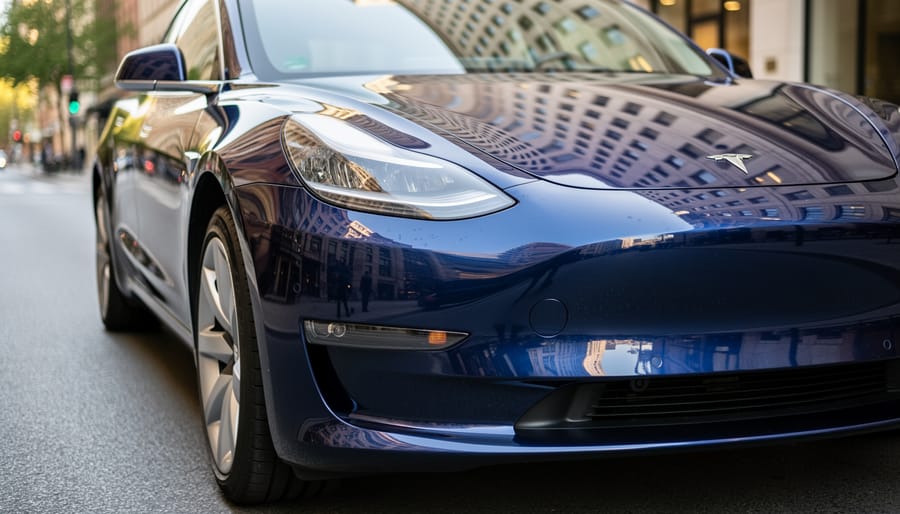
Paint protection film acts as a sacrificial barrier between your EV’s paint and the daily hazards of city driving. The thermoplastic urethane construction works through multiple protective layers that distribute impact energy across the film’s surface rather than allowing it to reach the paint underneath. When a rock strikes your hood or a shopping cart grazes your door, the film absorbs and disperses that force, the elastic properties allow it to flex on impact, preventing the sharp penetration that would otherwise chip or scratch your vehicle’s finish.
The self-healing characteristic sets quality PPF apart from simpler protective solutions. Light scratches and swirl marks that would normally mar your EV’s appearance actually disappear from the film’s top coat when exposed to heat. Park your Tesla or Rivian in Denver’s sunny climate, and minor abrasions from automated car washes or brushing past landscaping literally vanish as the film’s molecules realign. You can accelerate this process with warm water or a heat gun for deeper surface marks.
UV resistance protects your investment over years of exposure. The film’s formulation blocks degrading ultraviolet rays that would otherwise oxidize and fade paint, particularly relevant at Denver’s mile-high altitude where UV intensity runs 25% higher than at sea level. This matters for EVs because you’re likely keeping the vehicle longer to maximize your environmental impact and financial return.
Urban environments present specific threats that PPF directly counters:
- Stone chips from gravel trucks and construction zones
- Door dings in tight parking garages and crowded street spaces
- Bird droppings and tree sap that etch paint if left untreated
- Road salt and de-icing chemicals during winter months
- UV fading from constant sun exposure
- Minor scratches from parallel parking and pedestrian contact
Each of these hazards becomes routine when you navigate Denver’s streets daily. The film takes the damage so your paint doesn’t, and because it’s removable, you maintain the original factory finish underneath. That preserved condition directly translates to higher resale value when you eventually upgrade to your next electric vehicle.
Types of Paint Protection Film Coverage
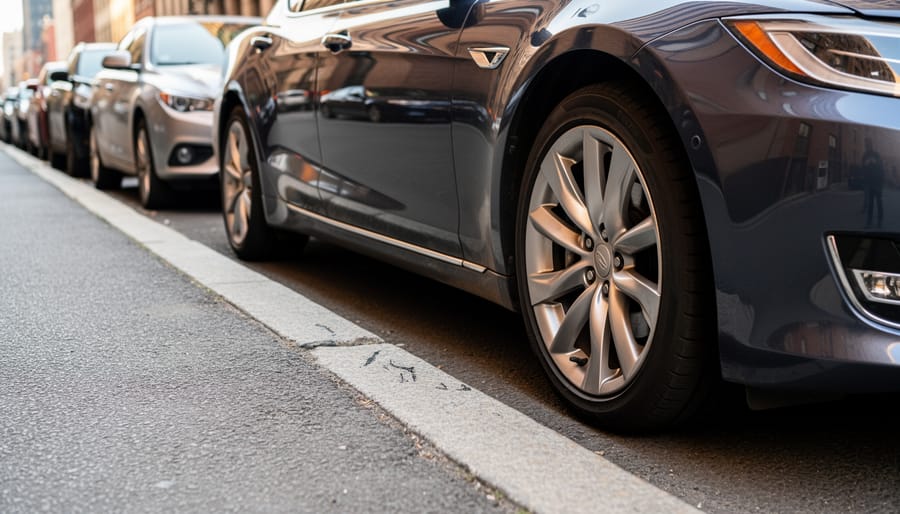
Partial Front-End Protection
Partial front-end protection covers the areas most vulnerable to road debris and urban driving hazards. This package typically includes the front bumper, hood, front fenders, side mirrors, and headlights, the surfaces that face oncoming traffic and parking obstacles daily.
For city EV owners, this configuration makes practical sense. Your front bumper absorbs the brunt of parking approaches and road spray, while the hood catches gravel kicked up by other vehicles. Side mirrors are particularly at risk in tight Denver parking situations and bike lane navigation.
This option costs significantly less than full-body coverage while protecting the zones that experience 80% of typical damage. Most installers can complete the application in one day, and the investment typically pays for itself by preventing a single hood repaint, which runs $500-1,000 in Denver’s body shops.
High-Impact Zone Coverage
High-impact zone coverage extends protection beyond the front end to areas that take constant abuse in city parking. This strategic approach adds film to door edges (where adjacent vehicles create chips and scratches), rocker panels (vulnerable to kicked-up debris and curb contact), and the rear bumper (facing loading zones and tight parallel parking maneuvers).
For Denver EV owners navigating crowded downtown garages or Capitol Hill street parking, these zones absorb daily wear that gradually diminishes appearance and resale value. The rocker panels especially benefit urban drivers, they sit low enough to catch road salt spray, gravel, and concrete curbs during winter months. Door edge protection prevents the white paint chips that appear after a single careless neighbor opens their door against yours. This middle-tier coverage costs less than full-body wraps while defending the specific surfaces your city environment threatens most.
Full-Body Protection
Full-body paint protection film wraps every painted surface of your EV, creating complete armor against urban hazards and outdoor adventures alike. This comprehensive approach makes particular sense for Denver EV owners who plan to keep their vehicles beyond the typical three-to-five-year lease cycle, since the upfront investment pays dividends through preserved condition and stronger resale values. If you frequently venture from city streets to mountain trailheads, exposing your EV to gravel roads, trail dust, and seasonal debris, full coverage shields against chips and scratches that partial protection misses. The environmental benefit aligns with Denver’s sustainability values: maintaining pristine condition means your EV remains desirable longer, reducing the pressure to replace it prematurely and extending the environmental payback period of its manufacturing footprint.
How City EV Owners Use Paint Protection Film
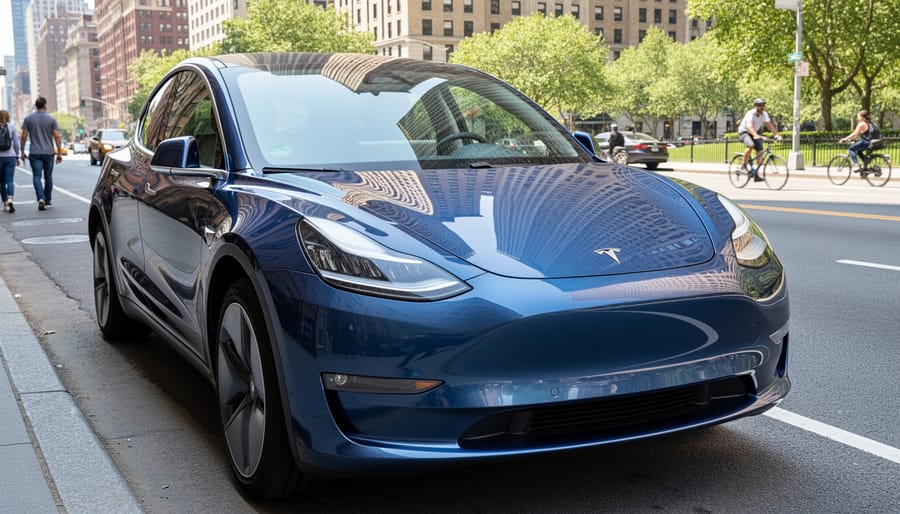
Denver EV owners face unique challenges that make paint protection film particularly valuable. Street parking exposes vehicles to careless door swings from adjacent cars, while multi-story garage pillars create tight navigation points where scrapes happen easily. Charging stations often sit in high-traffic areas where shopping carts, bicycles, and pedestrian traffic increase the risk of minor impacts. PPF creates a barrier that absorbs these daily insults, keeping the underlying paint pristine even after months of urban exposure.
The financial logic makes sense for city drivers planning to keep their EVs long-term. Denver’s strong used EV market rewards well-maintained vehicles, and PPF-protected cars command higher resale values because buyers can see the paint remains factory-fresh. Instead of budgeting for touch-up paint, bumper resprays, or panel repairs that generate chemical waste and consume energy, owners avoid those costs entirely. The film essentially pays for itself through prevented damage, particularly for models with special-order paint colors that cost thousands to repair correctly.
The sustainability connection runs deeper than avoiding repair waste. By protecting their EV investment, owners extend the vehicle’s useful life, which matters more than many realize. Manufacturing a new EV carries significant environmental costs, so keeping existing vehicles in excellent condition for 10, 12, or 15 years reduces overall resource consumption. PPF aligns with the same forward-thinking approach that drives EV adoption itself, making sustainable material choices that prioritize longevity over disposability.
Denver’s outdoor-oriented EV community also values PPF for maintaining pride of ownership. When your vehicle still looks showroom-new after three years of Capitol Hill street parking or daily trips to RiNo charging stations, you’re more likely to continue driving it rather than trading up unnecessarily. That extended ownership cycle represents real environmental impact, reducing the demand for new vehicle production while supporting the city’s clean energy transition.
What Denver EV Drivers Should Know Before Installing PPF
Before investing in paint protection film for your Denver EV, research certified installers with specific experience working on electric vehicles. Look for shops that understand EV paint systems and have portfolios showing work on models similar to yours. Many sustainable Denver businesses now offer PPF installation using eco-conscious practices, aligning with the values of EV ownership.
When evaluating installers and products, consider these essential factors:
- Installer certification from the film manufacturer whose product the installer actually fits
- Warranty coverage, typically 5-10 years against yellowing, cracking, and peeling
- Maintenance requirements, usually just regular washing with pH-neutral soap
- Removal process, professional removal should leave paint undamaged
- Installation timeline, quality applications take 1-3 days depending on coverage
- Cost versus your driving patterns, full-body protection ranges $4,000-$8,000
Denver’s mile-high altitude increases UV exposure by about 25 percent compared to sea level, accelerating paint degradation without protection. The film’s UV-blocking properties become especially valuable here. Seasonal considerations matter too, winter road salt and summer hail storms both threaten EV paint, making PPF a year-round asset rather than a luxury.
Sarah Chen, who drives a Rivian R1T in Capitol Hill, notes that her front-end PPF paid for itself within two years by preventing three rock chip repairs and maintaining her vehicle’s showroom appearance despite daily street parking. Another Denver EV owner, Marcus Williams, chose full-body coverage for his Tesla Model Y after calculating that preserving resale value would offset the initial investment when upgrading to newer EV technology in five years.
Proper maintenance requires only washing with non-abrasive products every two weeks. The self-healing properties activate in Denver’s sunny climate, erasing minor swirl marks naturally.
Common Questions About Paint Protection Film for EVs
City EV owners considering paint protection film often share similar concerns about the investment, and understanding these realities helps make informed decisions that align with both vehicle protection and sustainability goals.
The most pressing question for efficiency-minded EV drivers: does PPF affect range or aerodynamics? The film adds negligible weight, typically under 10 pounds for full-body coverage, and creates no measurable drag penalty. Your vehicle’s efficiency remains essentially unchanged, meaning you won’t sacrifice the environmental benefits that drew you to an EV in the first place.
How long does paint protection film actually last on a city EV?
Quality PPF typically lasts 7-10 years with proper maintenance, though Denver’s high altitude and intense UV exposure may shorten lifespan slightly. Most warranties cover 5-7 years against yellowing, cracking, and delamination.
Can PPF be removed without damaging the paint underneath?
Yes, professional removal leaves factory paint intact when done correctly. The film should be heated during removal to release the adhesive cleanly, a process typically taking 2-4 hours for full-body coverage.
Is the cost justified for daily urban driving versus occasional road trips?
City driving actually increases PPF’s value, tight parking, frequent door exposure, and stop-and-go traffic create more opportunities for paint damage than highway driving. The investment pays off through maintained resale value and avoided touch-up costs.
What’s the environmental footprint of adding PPF to my EV?
The film itself is petroleum-based, but preventing repaints (which require solvents, energy, and disposal of damaged panels) typically offsets the initial environmental cost within the first few years of protection.
Maintenance proves simpler than most owners expect. Regular washing with pH-neutral soap keeps the film clear, and you can use the same touchless car washes or hand-wash methods you’d use on bare paint. The self-healing properties mean minor swirls from washing disappear with heat exposure, either from the sun or a heat gun for stubborn marks.
Protecting your electric vehicle with paint protection film isn’t just about keeping it looking good, it’s a sustainability decision that aligns with why you chose an EV in the first place. By shielding your investment from the daily wear of city life, you’re extending your vehicle’s lifespan and reducing the need for paint repairs that generate chemical waste and resource consumption.
For Denver EV drivers, PPF makes particular sense. Our city’s commitment to clean energy and green transportation means more EVs on our streets, and protecting these vehicles helps ensure they remain functional, attractive assets for years to come. Every repair avoided is material not sent to a landfill, every maintained surface is value preserved in our community’s sustainable transportation infrastructure.
As you consider your options, connect with certified local installers who understand both EV-specific needs and Denver’s unique environmental conditions. Ask about warranty coverage, maintenance requirements, and their experience with electric vehicles. The right PPF installation becomes an extension of your commitment to responsible vehicle ownership, protecting what you’ve invested in while supporting the broader goal of sustainable urban mobility that makes our city cleaner and more livable for everyone.